International schools in Bangalore
Blog

Simple Weekend Activities to Strengthen Parent-Child Relationships

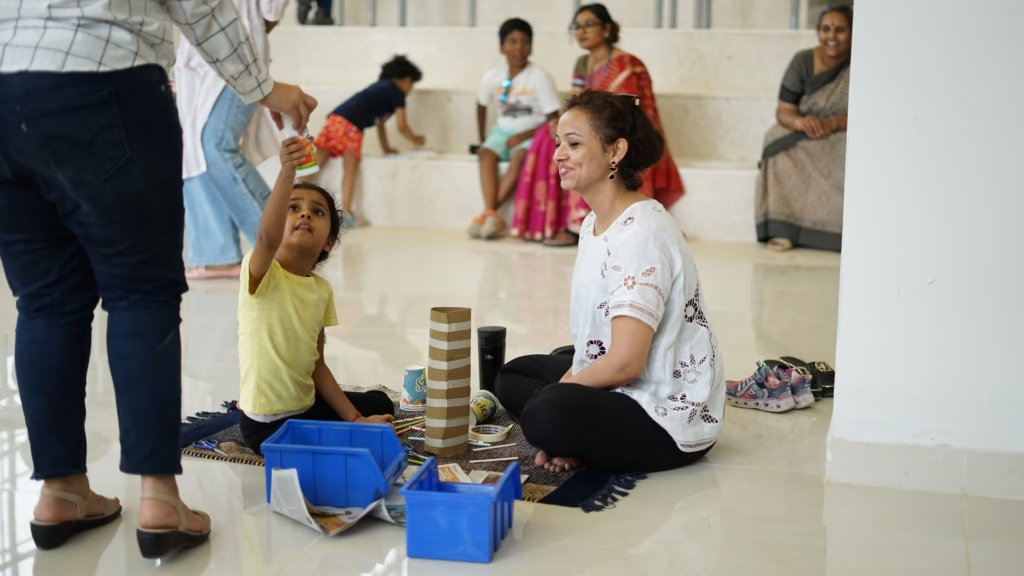
“What’s the Plan for This Weekend?” How many times have you heard this question from your child, or even asked it yourself? Weekends are a precious opportunity to step away from the usual hustle of work, school, and errands, and focus on what truly matters—spending quality time together. But let’s be honest: coming up with meaningful, fun activities that don’t require elaborate planning or spending a fortune can sometimes feel overwhelming. The truth is, you don’t need an extravagant plan to strengthen your bond with your child. It’s the little, intentional moments that leave the deepest impact—whether it’s giggling together over a silly game, working as a team to bake cookies, or simply exploring the world around you. Weekend Activities to Strengthen Parent-Child Relationships Let’s dive into some simple, creative, and engaging weekend activities that will leave you and your child closer than ever. 1. Turn Your Kitchen into a Makeshift Cooking Show Cooking together is an activity that’s as fun as it is rewarding. Let your child pick a recipe for the weekend—something simple like pancakes, pizza, or cookies—and work together to prepare it. Take turns mixing, kneading, or decorating, and let your child take the lead where possible. To make it even more exciting, turn it into a mini cooking show. Pretend you’re celebrity chefs narrating the process, or even record a short video for fun. Why it works: Cooking teaches teamwork and responsibility while encouraging creativity. Plus, it ends with a delicious treat that everyone can enjoy! Pro tip: Don’t worry about the mess—embrace it as part of the fun. 2. Go on an Adventure—Right in Your Neighborhood You don’t need to travel far to have an adventure. Explore your neighborhood with new eyes by turning a simple walk into a scavenger hunt. Create a list of things to find, like a red flower, a bird’s nest, or a unique-shaped rock. Alternatively, visit a nearby park and let your child take the lead. Climb trees, collect leaves, or lie on the grass and make shapes out of the clouds. Why it works: Nature has a calming effect on both kids and adults, and spending time outdoors fosters curiosity and mindfulness. Interactive idea: Bring along a notebook for your child to sketch or write about their discoveries. 3. Build Something Together Whether it’s a blanket fort in the living room, a LEGO masterpiece, or a simple birdhouse, building something together is an excellent way to bond. If you’re indoors, gather pillows, blankets, and chairs to create a cozy fort where you can read books, tell stories, or even watch a movie. Build something with your kids If you’re feeling adventurous, try building something outdoors—like a small garden patch or even a simple obstacle course in the backyard using household items. Why it works: Working together to create something fosters teamwork and gives a sense of accomplishment. Pro tip: Let your child’s imagination take the lead—sometimes, their wild ideas make for the best creations. 4. Unplug and Have a Family Game Marathon Turn off the TV, put away the phones, and spend an afternoon playing board games or card games. Classics like Uno, Ludo, or Snakes and Ladders are always a hit, but you can also try cooperative games like Jenga or Charades. For an added twist, create your own family trivia game, with questions about each other’s interests, favorite moments, or funny family memories. Why it works: Games bring in laughter, teamwork, and a little friendly competition, all while creating shared memories. Pro tip: Celebrate wins with small rewards or funny titles like “Game Champion of the Day.” 5. Dive into a Storytelling Adventure Storytelling is a wonderful way to connect with your child’s imagination. Instead of just reading a book, make it interactive. Take turns building a story, with each of you adding a few sentences. For example, your child might start with, “There was a tiger in the jungle…” and you could add, “…who wanted to learn how to fly!” If storytelling isn’t your thing, you can still share stories from your childhood. Kids love hearing about what their parents were like when they were younger—especially the funny or mischievous moments! Why it works: Storytelling sparks creativity, strengthens communication skills, and brings parents and children closer through shared laughter and ideas. Interactive idea: Write or draw the story together as you go, creating your very own book. 6. Create Your Own Mini Adventure Day Transform your home into an adventure zone by creating mini-challenges for you and your child to complete together. For example: Set up an indoor treasure hunt with clues leading to hidden surprises. Turn the living room into a mini obstacle course using pillows, chairs, and blankets. Have a 5-minute “dance-off” with your favorite music. Why it works: These small adventures are easy to set up, encourage movement, and spark excitement. Pro tip: Let your child create some of the challenges—they’ll enjoy being in charge! 7. Learn Something New Together Weekends are the perfect time to explore a new skill or hobby as a team. Try something your child has always been curious about, like origami, simple painting techniques, or even beginner yoga. Learn something new together If you’re feeling adventurous, look up a simple DIY science experiment—like making a baking soda volcano or creating slime. Why it works: Learning something new together creates a sense of partnership and makes the process exciting for both of you. Interactive idea: Document your progress with photos or videos to look back on later. 8. Slow Down with a Themed ‘Pajama Day’ Not every weekend needs to be action-packed. Sometimes, the best bonding moments happen when you slow down and simply enjoy each other’s company. Declare a “Pajama Day” and choose a theme: Movie Marathon: Watch a series of family-friendly movies and snack on popcorn. Book Day: Read your favorite stories together or create a cozy reading nook with pillows and blankets. Spa Day: Try face masks, paint each other’s nails, or give simple massages.

International schools in Bangalore
Blog

Ekya Nava’s Outbound Learning Program: Learning Beyond Boundaries

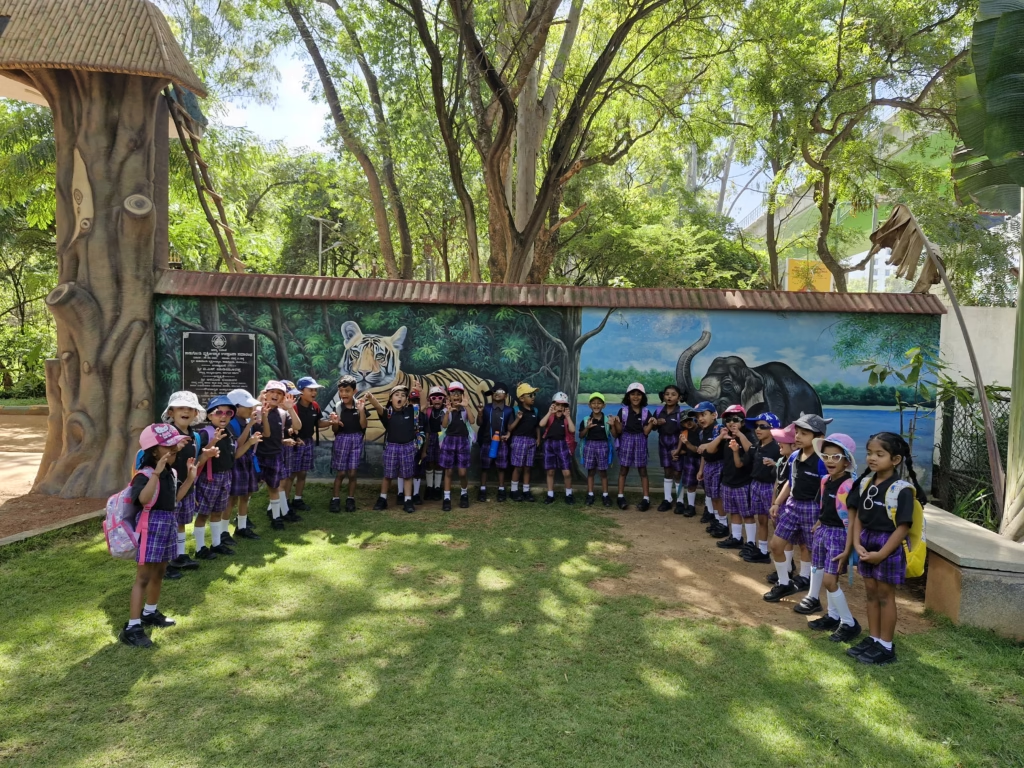
“Tell me and I forget. Teach me and I remember. Involve me and I learn.” – Benjamin Franklin How often do students truly connect with what they learn? At Ekya Nava, we believe that education is most impactful when it engages students in the real world. This is why our Outbound Learning Program is at the core of our efforts to create well-rounded learners. It’s not just about stepping out of classrooms but stepping into opportunities for exploration, growth, and discovery. Imagine students learning about sustainability while trekking through nature trails, understanding the intricacies of history in a museum, or gaining hands-on experience with science in interactive centers. These are the moments where learning becomes layered, meaningful, and unforgettable. At Ekya Nava, these experiences are carefully curated to help students connect classroom concepts to real-world applications, while also fostering critical life skills like teamwork, leadership, and adaptability. Let’s dive deeper into what makes the Outbound Learning Program an integral part of our educational philosophy. What Makes the Outbound Learning Program Unique? The Outbound Learning Program at Ekya Nava is built around four key themes: Experiential Learning: Students engage in hands-on activities that encourage critical thinking and problem-solving. Adventure: Activities that push students to step out of their comfort zones and build confidence. Sustainability: Promoting awareness and responsibility toward the environment. Service: Instilling a sense of empathy and responsibility through community-driven initiatives. Every trip is carefully planned and age-appropriate, ensuring that students derive maximum benefit from these experiences. From local excursions to immersive multi-day adventures, these trips offer students a chance to explore, discover, and grow. Highlights of Ekya Nava’s Outbound Trips Over the years, the Outbound Learning Program has taken students on incredible journeys, each designed to enrich their understanding of the world and themselves. Here are a few examples of the experiences that have left a lasting impact: 1. Exploring History and Heritage Students visited the Rizwan Rezack Indian Paper Money Museum, where they explored the evolution of Indian currency through fascinating exhibits. The trip provided insights into the history and technology behind paper money, sparking curiosity about economics and history. Visit to Rizwan Rezack Indian Paper Money Museum 2. Immersive Science Experiences A visit to the Param Science Experience Center (PARSEC) allowed students to dive deeper into the world of science and technology. Through hands-on exhibits and guided learning, they gained a better understanding of scientific concepts and were encouraged to ask questions and think critically. A visit to the Param Science Experience Center (PARSEC) 3. Outdoor Adventures with Families The parent-child overnight camping experience at Rocksport Kanakapura created unforgettable memories. Parents and children bonded over outdoor adventures and fun activities, strengthening relationships while enjoying nature. The parent-child camping at Rocksport Kanakapura 4. A Journey Through Space A field trip to a planetarium took students on a journey beyond Earth, where they experienced a mesmerizing ceiling show and explored models like Chandrayaan. The science park offered hands-on experiments, sparking their curiosity about astronomy and space exploration. 5. Winter Trekking Adventures The parent-child winter trek to Biddarkatta was an adventurous experience that combined physical fitness and family bonding. Participants trekked through beautiful landscapes and learned about teamwork, resilience, and the great outdoors. The Impact of Outbound Learning The value of outbound learning goes far beyond the trips themselves. These experiences play a key role in shaping students’ academic and personal growth. Building Confidence: Stepping into new environments and taking on challenges helps students build self-esteem and trust in their abilities. Fostering Teamwork and Leadership: Group activities encourage collaboration, communication, and leadership skills, preparing students for future roles. Enhancing Academic Learning: Trips are designed to connect classroom concepts to real-world applications, making learning more engaging and memorable. Encouraging Curiosity: Exploring new places and ideas inspires students to ask questions, seek answers, and embrace lifelong learning. Promoting Sustainability and Responsibility: Activities like nature treks and environmental projects encourage students to appreciate and care for the planet. Transforming Education Through Exploration At Ekya Nava, we see the world as the ultimate classroom. The Outbound Learning Program is a testament to our belief in offering students experiences that empower them to discover, learn, and grow. Through these carefully curated trips, students don’t just connect classroom concepts to the real world—they discover themselves, their passions, and the endless possibilities around them. As one of the leading schools in Bangalore, Ekya Nava is committed to redefining education by providing enriching opportunities that go beyond traditional methods. If you’re looking for a school that values experiential learning and holistic development, Ekya Nava is where the journey begins. Let’s inspire the next generation of learners to explore, engage, and excel in every walk of life.

News

Ekya Schools celebrates FIND Festival 2023: India’s first K-12 Global learning Festival

 Bengaluru  – Ekya Schools celebrated a significant milestone in K-12 education with the successful culmination of the Ekya FIND Festival 2023 on 4th November. Hosted at the CMRIT Campus, Bengaluru, the event brought together a vibrant community of educators, students, and thought leaders, all dedicated to reshaping the future of education. The festival, themed “World of Learning, Learners, and Extraordinary Educators,” was inaugurated by Dr. Tristha Ramamurthy, Founder of Ekya Schools. Her opening remarks set the tone for the event, emphasizing the importance of innovation and community in education. “Positioned as India’s pioneering global learning platform, the FIND Festival 2023 emerges as a transformative force in the K-12 education arena. It aimed to address gaps prevalent in education festivals, embodying a commitment to innovation, celebrating educational excellence, and exploring progressive practices. I am elated to see great participation from the stakeholders globally. Ekya Schools will passionately drive this movement in the times to come, reflecting our dedication to empower a community propelled by learning, innovation, and the pursuit of global educational excellence.” she stated…Read more!

News

Ekya Schools Launches Ekya Nava; Asia’s First K-12 Maker School of Innovation, Creativity & Design

Bengaluru (Karnataka) [India], November 4: Ekya Schools celebrated a significant milestone in K-12 education with the unveiling of Ekya Nava – Asia-EMEA’s inaugural K-12 Maker School of Innovation, Creativity, and Design. This groundbreaking venture promises to transform India’s educational landscape by moving from traditional rote learning to a purpose-driven academic approach. Ekya Nava stands as a beacon for the ‘Maker Movement’ in India, poised to cultivate the upcoming generation of thinkers, innovators, and technology-forward entrepreneurs…Read More!

News

Ekya Schools Announces FIND Festival 2023: India’s One-of-a-Kind K-12 Education Extravaganza

BANGALORE  – Ekya Schools is set to redefine educational festivities with the upcoming “Ekya FIND Festival 2023” on 4th November, 2023 at the CMRIT Campus, Bengaluru. A first-of-its-kind event aimed at reshaping the landscape of K-12 education. With its theme “World of Learning, Learners, and Extraordinary Educators,” the festival promises to unite and inspire educators, students, school leaders, policymakers, and education enthusiasts from across the globe. We are honoured to have our Chief Guests: Shri. Rajeev Chandrasekhar, Honourable Minister of State for Skill Development & Entrepreneurship and Electronics & Information Technology; Dr. A. S. Kiran Kumar, Former Chairman, ISRO; and Dr. K. P. Gopalkrishna, Founder & Chairman of National Public Schools. Our Guest of Honour for the event will be Dr. K. C. Ramamurthy, IPS (Retd.), Former Member of Parliament and the function will be presided over by Dr. Sabitha Ramamurthy, President, CMR Jnanadhara Trust along with Shri. K. R. Jayadeep, Director, Ekya Schools, and Dr. Tristha Ramamurthy, Founder, Ekya Schools. At the heart of this year’s FIND Festival, Ekya Schools will present a revolutionary concept: Asia’s first K-12 Maker School. Envisioned to be a nexus of innovation, creativity, and design, this school aspires to redefine traditional learning, tapping into each student’s innate purpose and nurturing their creative potential. On the other hand, the festival will also witness the launch of “Creating Extraordinary Educators”. This book, a model of Ekya’s 12-year educational ethos, offers insights and narratives, challenging and inspiring educators to transcend conventional teaching paradigms…Read More!

News

Minister Rajeev Chandrasekhar to attend inaugural FIND Festival ’23 and Ekya Nava launch

Union Minister of State for Skill Development & Entrepreneurship and Electronics & IT, Shri Rajeev Chandrasekhar, is set to attend the FIND Festival ’23, an initiative by Ekya Schools aimed at transforming K-12 education and the launch of Ekya Nava, a new frontier in K-12 educational innovation in Bengaluru. The participation of Minister Shri Rajeev Chandrasekhar highlights the importance of government support in educational innovation and the shared vision of preparing India’s youth for the challenges of the future. The Minister will highlight Prime Minister Shri Narendra Modi’s commitment to educational excellence and technological advancement in the learning sector. The day’s proceedings will include a panel discussion featuring leaders from the educational and entrepreneurial sectors, including Dr Bindu Hari, Shri Mekin Maheshwari and Shri Azeez Gupta, with Shri Akshay Saxena moderating the session providing a platform for dialogue and exchange of ideas. Minister Shri Rajeev Chandrasekhar will be interacting with academia, students, policy makers and prominent leaders of the education sector from Karnataka who will be attending this event. The event will introduce Ekya Nava, a new model in K-12 education focusing on innovation, creativity, and design thinking…Read More!

News

Ekya Schools celebrates FIND Festival 2023: India’s first K-12 Global learning Festival

Bengaluru , November 06,  2023 :   Ekya Schools celebrated a significant milestone in K-12 education with the successful culmination of the Ekya FIND Festival 2023 on 4th November. Hosted at the CMRIT Campus, Bengaluru, the event brought together a vibrant community of educators, students, and thought leaders, all dedicated to reshaping the future of education. The festival, themed “World of Learning, Learners, and Extraordinary Educators,” was inaugurated by Dr. Tristha Ramamurthy, Founder of Ekya Schools. Her opening remarks set the tone for the event, emphasizing the importance of innovation and community in education. “Positioned as India’s pioneering global learning platform, the FIND Festival 2023 emerges as a transformative force in the K-12 education arena. It aimed to address gaps prevalent in education festivals, embodying a commitment to innovation, celebrating educational excellence, and exploring progressive practices…Read More!

International schools in Bangalore
Blog

Purpose Based Learning : The Missing Piece in Your Child’s Education Journey

Is Your Child Learning Why They Are Learning? What if the most important question in your child’s education isn’t what they’re learning, but why they’re learning it? Think about it—when children understand the purpose behind their education, their motivation skyrockets, their understanding deepens, and they begin to see how their lessons connect to their own goals and the world around them. Purpose is the invisible compass that guides children toward success, fulfillment, and meaningful contributions to society. Yet, in many schools, this crucial element is missing, leaving students to focus solely on grades or rote memorisation. At Ekya Nava, one of the leading IGCSE schools in Bangalore, we believe that education must go beyond academics. It should empower children to find their purpose, connect their learning to real-world challenges, and discover why their education truly matters. In this blog, we’ll dive into the concept of purpose-based learning, explore its transformative benefits, and show how schools in Bangalore can help your child thrive in an increasingly complex world. Is Your Child Learning Why They Are Learning? Purpose-based learning is an educational approach that helps students discover the why behind their lessons. Instead of focusing solely on academic outcomes, it emphasizes connection—between a child’s passions, their studies, and the world around them. When students see how their education impacts their lives and society, they become active participants in their learning journey. Purpose based learning as a tool to success Unlike traditional methods that prioritize grades and exams, purpose-based learning nurtures: Relevance: Students see how their lessons apply to real-world problems. Ownership: Children take charge of their education, motivated by personal goals. Holistic Development: It integrates emotional, intellectual, and social growth. This approach is increasingly embraced by international schools in Bangalore, as it prepares students for the demands of a globalized, fast-changing world. Why Purpose Matters in Education 1. Ignites Intrinsic Motivation Children thrive when they understand how their education aligns with their values and passions. Purpose-based learning inspires students to engage deeply with their studies because the lessons feel meaningful. For example, when students in IGCSE schools in Bangalore study sustainability, they’re not just learning abstract science concepts—they’re discovering how they can make a difference in their communities. 2. Develops Critical Thinking and Problem-Solving Skills Purpose-based learning challenges students to think beyond textbooks. It encourages them to apply their knowledge to solve real-world issues, fostering creativity and critical thinking. Whether it’s designing a project to tackle climate change or exploring how technology impacts society, students learn to approach problems with a solutions-oriented mindset—skills that are essential for the 21st century. Develops critical thinking and problem-solving skills 3. Builds Emotional and Social Intelligence Education isn’t just about academics—it’s about preparing children to navigate the complexities of life. Purpose-driven learning helps students develop empathy, collaboration, and resilience. By working on projects that connect to real-world challenges, students learn to communicate effectively, listen to diverse perspectives, and build meaningful relationships. 4. Prepares Students for the Future In an ever-changing world, technical knowledge alone isn’t enough. Employers and universities are looking for individuals who can adapt, innovate, and bring a sense of purpose to their work. Purpose-based learning equips students with these qualities, making them future-ready. Many schools in Bangalore offering purpose-driven education ensure their students are prepared for both academic and personal success. 5. Fosters a Lifelong Love for Learning When students understand the “why” behind their education, they develop a natural curiosity and a lifelong love for learning. Purpose-based learning shifts the focus from grades to growth, encouraging children to explore, experiment, and innovate. It’s a philosophy embraced by top international schools in Bangalore, where students are taught to think beyond exams and discover their potential. How Ekya Nava Champions Purpose-Based Learning At Ekya Nava, we’ve reimagined education by putting purpose at the center of everything we do. As one of the leading IGCSE schools in Bangalore, we believe that students learn best when they see the relevance of their education and feel empowered to make meaningful contributions to the world. Here’s how we bring purpose to life in our classrooms: Ekya Nava champions Purpose-Based Learning Personalised Journeys: Every child is unique, and we tailor education to their individual strengths, passions, and goals. Real-World Applications: By connecting lessons to real-world challenges, we ensure students see the value of their education. Collaborative Projects: Our students work in teams to develop empathy, teamwork, and communication skills. Reflection and Goal-Setting: We encourage students to reflect on their learning journey and set meaningful goals for themselves. At Ekya Nava, we don’t just teach students what to learn—we inspire them to discover why it matters. Your Role as a Parent: Supporting Purpose-Based Learning As a parent, you play an essential role in nurturing your child’s sense of purpose. Here’s how you can support purpose-based learning at home: Encourage Exploration: Let your child try new activities, hobbies, and experiences to discover their passions. Ask Reflective Questions: Help them think about how their studies connect to their goals and the world around them. Celebrate Growth Over Grades: Teach your child to value effort, curiosity, and in progress rather than just academic results. When parents and schools work together to foster purpose-driven learning, children thrive academically, emotionally, and socially. Purpose-Driven Learning for a Purpose-Filled Life Education is not just about memorising facts or acing exams—it’s about helping children find their purpose and use their knowledge to make a difference. Purpose-based learning transforms classrooms into spaces of inspiration, growth, and discovery, ensuring that students are prepared not just for academic success but for life itself. At Ekya Nava, one of the top international schools in Bangalore, we are committed to helping students discover their purpose and unlock their full potential. By choosing schools that prioritise purpose, you’re giving your child the tools they need to thrive in an ever-changing world. So, ask yourself: Is your child’s education preparing them for a career, or for a life filled with purpose? Let’s work together to create a future where every child learns not just

IGCSE schools in Bangalore
Blog

Design Thinking for Children: A Guide to Creative Learning

Have you ever paused, mid-task, to wonder why we cling to conventional problem-solving methods in a world that’s evolving faster than ever? It’s a bit like relying on a paper map in the age of digital navigation—a comforting habit, perhaps, but hardly efficient. This is where Design Thinking comes into play, acting as a compass for innovation in the rapidly changing landscapes we navigate daily. Forgoing the creating more approach; Design Thinking focuses on creating with intention. It’s a philosophy that doesn’t start from the assumption that we already have all the answers. Instead, it invites curiosity, encourages a deep dive into the human experience, and advocates for solutions that are both effective and meaningful. In essence, it asks us to shift our perspective—away from the what and towards the why and the who. In this exploration, we’re peeling back the layers of Design Thinking to reveal its core: a blend of empathy, creativity, and strategy that challenges us to rethink how we approach not just design, but problem-solving at large. What is Design Thinking? You’ve likely navigated through countless problem-solving methods, each promising to be the key to unlocking innovation. Yet, how often do we pause and question their effectiveness in the real, complicated world we’re trying to improve? This brings us to Design Thinking, a concept that steps out from the shadows of conventional methods, challenging us to rethink the way we approach problems. At the heart of Design Thinking lies a simple yet profound truth: understanding. It’s about getting to the core of people’s needs, desires, and experiences. But it doesn’t stop there. This approach intertwines creativity with practicality, weaving through disciplines and mindsets to find solutions that are not just novel, but truly necessary. Significance of Design Thinking Design Thinking asks us to shift our gaze from the immediate and convenient to the impactful and meaningful. It’s about building bridges between what is and what could be, guided by the stories, needs, and lives of those we’re designing for. The Process of Design Thinking Here are the 5 key steps involved in creating real-life solutions using design thinking: Empathise: The journey into Design Thinking commences with empathy, akin to an explorer gathering insights from uncharted territories. For instance, a health app developer shadowing doctors in a bustling clinic, observing their challenges and interactions with patients firsthand. This immersive exploration is about understanding the nuanced needs and pains of those we’re designing for, setting the stage for meaningful innovation. Define: With a wealth of observational data, the next step is to distill this into a precise definition of the problem. It’s similar to an author outlining the central conflict of a novel. For instance, the health app team might identify the crucial challenge as “streamlining patient data entry to maximize face-to-face consultation time.” This phase sharpens our focus, ensuring we aim our creative efforts where they can make the most difference. The steps of design thinking Ideate: Now, it’s time to brainstorm solutions, where quantity trumps quality, and every idea is welcomed. Think of a room filled with post-it notes, each one representing a potential solution, from the wildly imaginative to the straightforward fixes. It’s a phase reminiscent of a brainstorming session for an advertising campaign, where no idea is too out there, encouraging a divergence of thought that fosters true innovation. Prototype: With a trove of ideas at our disposal, we select the most promising and start building prototypes. Like a tech startup creating a basic version of a new social platform feature to see how users interact with it. This stage is about experimentation and tangibility, transforming abstract ideas into concrete, testable forms. It’s a hands-on phase where the goal is to learn through making. Test: The final stage is testing, where prototypes are exposed to real-world scenarios and users. Feedback collected here is gold, offering direct insights into how well the solutions meet the user’s needs and what adjustments are necessary. It could be likened to a chef hosting a tasting menu before finalising a restaurant’s new dishes, where each critique is an opportunity to refine and perfect. The Iterative Loop Crucially, the Design Thinking process is inherently iterative. Insights from testing can loop us back to any previous stage, armed with new understandings that demand we re-think, re-define, or re-ideate. It’s a dynamic process that resembles the development cycle of a software product, constantly evolving in response to user feedback and technological advancements. The Origins and Evolution of Design Thinking The story of Design Thinking begins in the intellectual climate of the 1960s, a period ripe for the birth of innovative concepts. This era saw the convergence of minds seeking to understand not just the ‘how’ but the ‘why’ behind design. A Spark in the 60s Herbert Simon stands as a pioneering figure during these formative years. His insights laid the groundwork, viewing design not just as an artistic endeavour but as a complex, structured process aimed at solving problems. Simon introduced the world to the idea that the essence of design lies in the thoughtful consideration of human needs and experiences. The Role of Visionaries and Institutions Fast forward to the late 20th century, and we witness the rise of IDEO and the Stanford d.school, institutions that took Simon’s foundational ideas and propelled them into the mainstream. IDEO, with its human-centered approach, transformed Design Thinking into a universally accessible methodology. Concurrently, the d.school at Stanford became a hub of interdisciplinary collaboration, educating generations in the art and science of Design Thinking. IDEO’s Influence Under IDEO’s stewardship, Design Thinking evolved from a niche concept to a global movement. They crafted a language and a process for Design Thinking that demystified design for professionals across industries, emphasizing the importance of empathy, prototyping, and iteration. Stanford’s Contribution The d.school’s inception in 2004 marked a pivotal moment in Design Thinking’s journey. Founded by David Kelley, the institution became a crucible for innovation, melding diverse disciplines and fostering an environment where students and professionals alike could

Blog

Unlocking India’s 10trillion-dollar Potential: The Role of Purpose-Based Education in Fostering Innovation and Specialized Talents

India’s journey toward becoming a 10 trillion-dollar economy hinges on the transformative power of education. Traditional classrooms encourage rote learning and proficiency in competitive exams with the intention of preparing students for existing job roles. But with rapid advancements in AI and an increased reliance on digital connectivity—as starkly highlighted during the Covid-19 pandemic—the need to prepare students for a future where job landscapes are continuously evolving is evident. The workforce of tomorrow must be versatile, innovative, and adaptable to contribute meaningfully to the nation’s growth. To this end, it’s clear that a fundamental reimagining of our educational practices is imperative. A shift towards purpose-based education holds the key to unlocking the potential of India’s youth. Purpose-based schools emphasize personalized, meaningful learning experiences tailored to each student’s strength, interests, and values. Rather than following a one-size-fits-all curriculum, purpose based schools aim to cultivate a sense of purpose in each student, aligning educational content with students’ passions and real-world applications of their skills.  This educational paradigm prioritizes learning that extends beyond the pages of a textbook, encouraging students to engage with real-world challenges and imbue their learning with a sense of mission. Imagine a computer science classroom where the focus shifts from explaining coding principles to enabling students to apply their skills in creating a program that addresses waste management in their school. Such a curriculum doesn’t stop there—it also empowers students with the entrepreneurial skills to pitch their innovative solutions to potential backers. This immersive, enjoyable approach not only cements the relevance of academic subjects but also equips students with the essential problem-solving skills and adaptability they’ll need in the workforce. Project-based learning is a cornerstone of this purpose-driven educational model, bringing academic concepts to life through practical application. It’s about learners taking theory into the real world, allowing them to understand the societal impact of their knowledge. Schools are increasingly collaborating with businesses, offering students hands-on projects that mirror current industry demands. Internships and project work in areas such as app development, design, and NGO initiatives provide invaluable insights into professional spheres, laying the groundwork for students’ future careers. Teachers in this new educational landscape are far more than information deliverers; they are mentors attuned to each student’s interests and capabilities, guiding their mentees through challenges and fostering a resilient, exploratory spirit. A student fascinated by robotics, for example, might receive tailored resources and project suggestions to deepen their engagement with the field. This mentorship can have a profound impact on a student’s career path, sparking a journey toward a fulfilling professional life. Technology’s role in this educational shift transcends the presence of gadgets and software in the classroom. It’s about leveraging technology to make learning a dynamic and interactive experience, transcending geographical barriers and cultivating a global perspective among learners. The use of technology should broaden students’ imaginations, enabling them to think forward and contribute constructively to society. As we set our sights on the ambitious goal of a 10 trillion-dollar economy, it is evident that our educational systems must be recalibrated to foster this progression. Purpose-based education, with its emphasis on practicality, real-world engagement, mentorship, and technological integration, is pivotal to nurturing the agile and innovative minds that will lead India’s economic revolution. This is a collaborative venture, one that requires the active participation of educators, students, institutions, industries, and the government. Together, we must embrace and drive this transformation, ensuring that the learning of today is relevant for the unpredictabilities of tomorrow.

Scroll to Top